Timber or steel posts in Mackay: what the sources can say
Timber or steel? The sources we read do not pick a winner, and this page does not either. They do give a way to ask the right question: a timber industry body describes hazard classes for treated timber, and a regional fact sheet notes where steel posts help in fire country. They give no neutral figure for post life, no termite pressure figure for the Mackay region and no corrosion rate, so we publish none.
What follows is what the hazard classes say, where termites appear in them, what wet ground and floods do to the soil around a post, and the questions that belong in a written quote. The cost and quote guide shows where those questions sit in the full list.
What H4 and H5 mean for fence posts
Treated timber is sold by hazard class. The timber industry body's table, as we read it, describes the classes below in these words (a timber industry body's use class table).
| Class | How the table describes it | Threats listed |
|---|---|---|
| H3 | Outside, above ground, exposed to periodic wetting and leaching, and allowed to dry after each wetting episode | Fungal decay and insects. Termites are not named. |
| H4 | Outside, in ground or continuously damp, non-critical applications such as landscaping and fence posts | Termites are listed. |
| H5 | Outside, in ground or fresh water, critical structural applications such as retaining walls, piles, and stumps | Termites are listed. |
Fence posts are named only under H4. That is what the table says. It does not say which class a particular fence should use, whether an H5 post is a better choice for a cattle fence, or how a treated post performs in Mackay ground. Those are questions for the contractor and the supplier.
Where termites fit, and where the sources stop
The table lists termites as a threat for H2, H4 and H5, and not for H3. That is all it says about them. We found no source on termite pressure in the Mackay region, so we do not say termites are common or rare in Mackay, the Pioneer Valley or anywhere else. If termites are a worry on your block, say so when you ask for quotes, and ask the contractor what they have seen on similar ground and how the posts are treated.
Wet ground, flood and the soil around the post
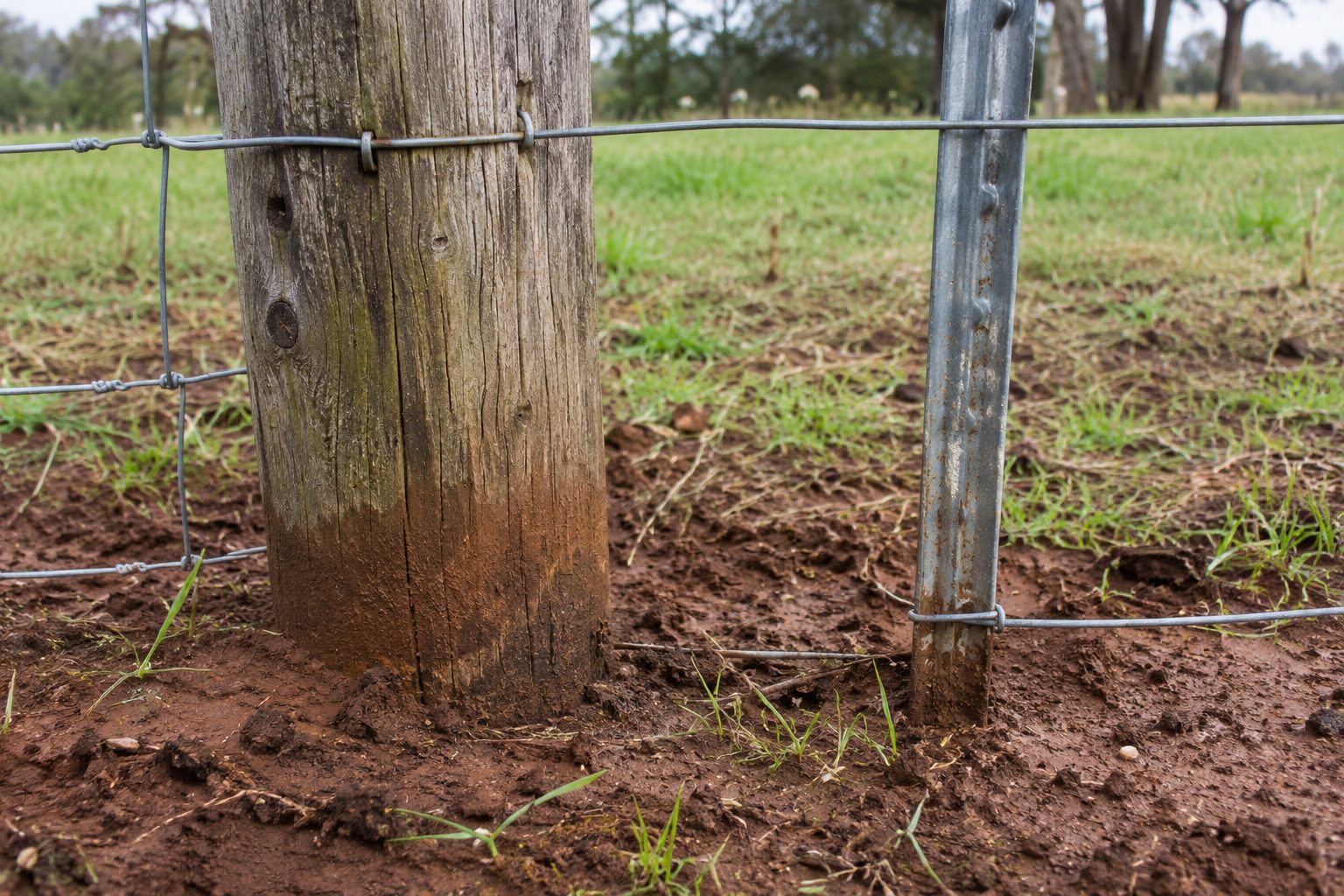
A post sits in the ground, so the soil matters. The only soils source we read is a 2003 study of the Whitsunday coast, and it is old and local to that coast (the 2003 Whitsunday coast soils study). It describes one soil as very dispersive and prone to severe gully erosion, and says backplains are often poorly drained and flood relatively frequently. We found no soils source for Mackay, the Pioneer Valley or Nebo, so treat soils as a question for the contractor: what the ground is like on your line, and how the posts are set in it.
Flood is the other test. A news report quotes manufacturers' representatives, so these are supplier views, saying flood debris can pull up to 1.5 m of soil from under posts and that stronger fences may catch more debris (a rural news report on flood fencing). The council's calendar puts the wet season, when flood risk is mainly high, at 1 November to May, and says flooding can happen at any time of year. The storm and flood repair page has the design points and the seasons guide has the rainfall.
Steel posts in fire country
One regional fact sheet says steel posts and porcelain insulators can reduce fire danger in fire-prone areas, and that fence lines can make firebreaks (a regional fence selection fact sheet). It is general information, not a mandatory standard. It gives no corrosion rate or coating life for steel, so if the quote lists steel, ask what the galvanising or coating is and what the contractor knows of it on similar ground.
Questions to put to the contractor
- Which hazard class or hardwood species are the posts, and how are they treated? Ask for the answer in writing on the quote.
- Which posts go where? Strainer posts, line posts and gate posts may be different, and the cattle and farm fencing page describes the strainer assemblies a regional fact sheet lists.
- How are posts set in wet ground? Ask whether the plan changes if the ground is sodden when the work starts.
- What if the line floods? Ask how the design handles debris and scour.
- If steel, what is the coating? Ask what it is and what it is based on.
When you have the answers, send the town, a photo of the line and anything you know about the ground, and the enquiry goes to a local contractor.
Why this page gives no post life
People ask how long a post lasts in the tropics. We looked for a neutral source and found none: no figure for timber, steel or coatings that we could stand behind. A number from a supplier is a sales claim, and a number from another climate is not Mackay's. So this page gives no figure, and we would rather say that than guess. The contractor's experience on your kind of ground is the better guide, and it belongs in the quote.
What this page cannot do
This page cannot tell you which post suits your fence, how long it will stay serviceable, how common termites are in Mackay, or what the soil is like on your block. The sources we read do not say. It does not recommend a product, a supplier or a contractor. We are a referral service: we pass your enquiry to local contractors, who choose and install the posts and are responsible for holding any licence or registration that applies. Ask for post details in writing on the quote.
Check the current rules before you rely on this
This page describes what the timber hazard class table, a regional fact sheet, an old coastal soils study and one news report say about fence posts. It describes the rules in general terms as they stood in November 2026. Standards, forms, thresholds and fines change.
The authoritative sources are A timber industry body, preservative treatments and use classes, A regional natural resource management body, fence selection fact sheet, August 2023 (general information, not mandatory standards), Whitsunday Shire Council, Whitsunday coast soils and land suitability study (2003; old; Whitsunday coast only) and Queensland Country Life, rebuilding boundary fencing after floods (news, 5 June 2025; suppliers' views). Where anything here differs from those sources, they are right and we are not.
We are not fencing contractors, builders, regulators or lawyers. For what applies to your fence, ask the contractor which licence or registration they hold and check it on the QBCC register (139 333), then ask the council that covers the land: Mackay Regional Council (1300 622 529), Whitsunday Regional Council (1300 972 753) or Isaac Regional Council (contact details on its website).
Accurate at the time of writing, November 2026. Always check the source before relying on it.