Flood damaged fence repair in Mackay: what this page covers
A flood damaged fence in the Mackay region usually needs three decisions: whether to repair or rebuild, whether to change the design so the next flood does less damage, and who pays if the fence is shared with a neighbour. This page sets out the flood and cyclone record, the design points two sources raise, how urgent fencing work and contribution work in Queensland, the recovery funding that was announced as at November 2026, and how to check a repair quote. We are a referral service: your enquiry is passed to a local contractor, who does the work and is responsible for holding any licence or registration that applies.
Planning a build around the seasons is a different question, and it is on the seasons guide.
What the flood and cyclone record shows
The council's hazard calendar gives the wet season, 1 November to May, as when flood risk is mainly high, and says flooding can happen at any time of year, with or without a cyclone (Mackay Regional Council). The Bureau of Meteorology says Cyclone Debbie made landfall near Airlie Beach at about 12:40pm on Tuesday 28 March 2017, category 4 over the Whitsunday islands and category 3 when it crossed the coast (the council's list calls it category 4). It recorded gusts to 165 km/h at Proserpine and 986 mm in the 48 hours to 9am on 29 March at the Clarke Range, and the Pioneer River flooded at Mackay (Bureau of Meteorology).
The Pioneer River responds fast: the peak travel time from Mirani to Mackay is generally 3 to 6 hours. The Bureau's flood brochure, which has records back to 1884, gives the figures below (Pioneer River flood brochure).
| Event | Finch Hatton | Mirani | Mackay |
|---|---|---|---|
| January 2026, Tropical Cyclone Koji | 7.28 m | 11.56 m | 6.15 m |
| 2024 | Not given here | Not given here | 7.12 m |
The Pioneer Valley page and the Proserpine and Calen page have the local detail.
Flood-friendly design: what two sources say
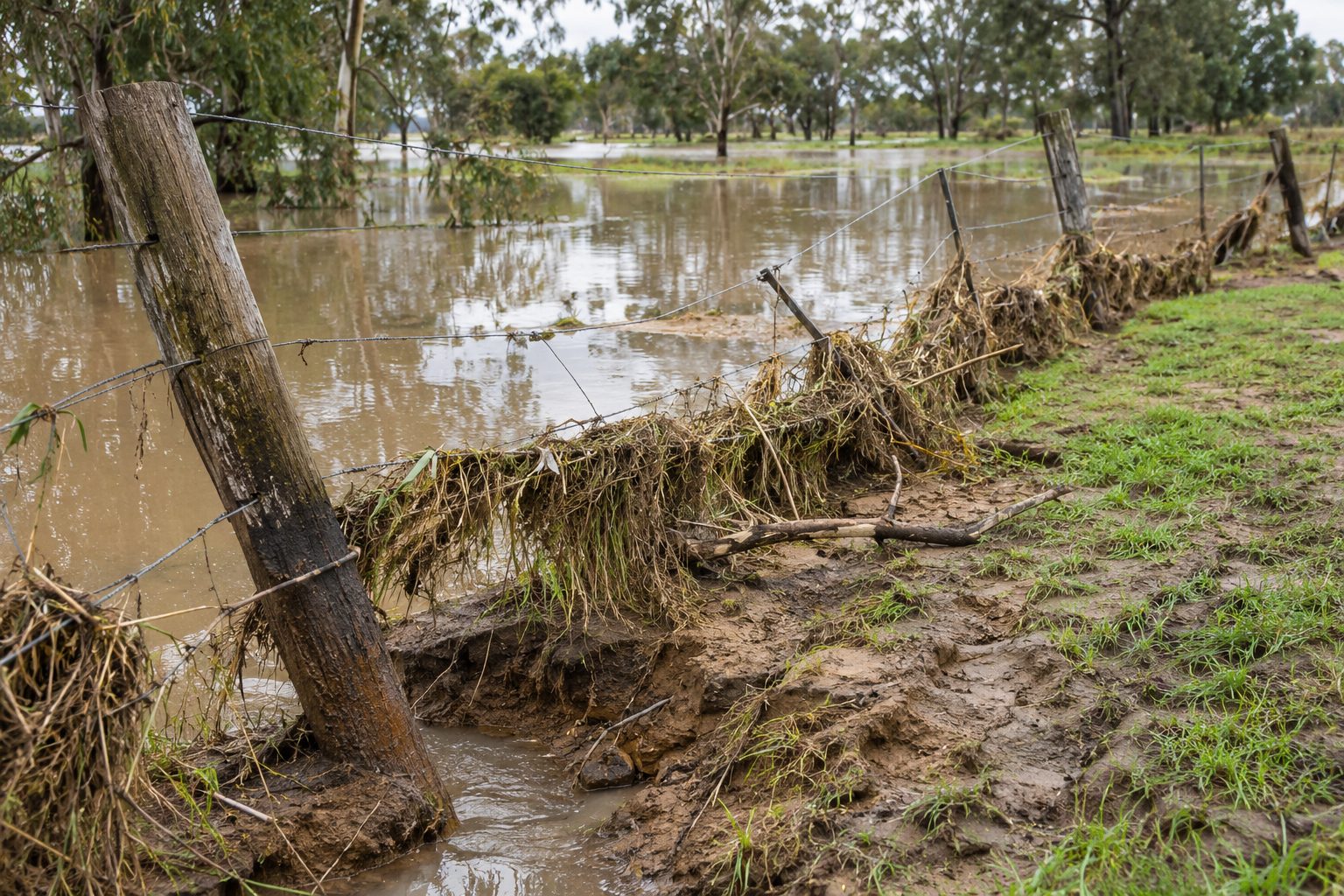
One regional fact sheet, which calls itself general information and not mandatory standards, says that in flood-prone areas fencing should be set back from waterways and built to handle inundation and debris. It should be "placed parallel to the anticipated direction of flood flow". It says plain wire collects less debris, and that hanging suspension, drop and lay-down designs can reduce damage (regional fence selection fact sheet).
A news report of 5 June 2025, secondary, quotes manufacturers' representatives speaking after floods in western Queensland, so these are supplier views (flood fencing news report). They said flood debris can pull up to 1.5 m of soil from under posts, that stronger fences may catch more debris, and that earthworks should be planned. A raised earth mound along the fence line can divert water and reduce damage in minor floods, they said, and drill-stemmed posts spaced about "six or seven metres" apart can reinforce a fence. Ask the contractor which of these they would use on your line and why.
Repair or rebuild, and what a repair quote should say
A regional pig exclusion sheet says maintenance is continuous and includes repairing breaches made by "fallen timber and floods". After a flood, ask the contractor to say what is repair and what is a change in design. The quote should itemise the length of fence, strainers and gates replaced, posts and how they are set (scoured ground matters), wire and number of strands, tying off, earthworks and erosion control, clearing, an underground services check and the post driver arrangements. The cost guide has the checklist. We publish no prices.
On clearing, the Queensland Government's clearing exemptions page has a separate row for maintaining existing infrastructure, including fences, with no width stated. Which vegetation category applies to a block is not answerable from those pages, so confirm it with the council. See the creeks, roads and vegetation page. A carrier's media release we read treats driving in a star picket as ground-breaking work and says to dial 1100 in business hours.
Urgent fencing work and a shared fence
If a flood or storm takes down a fence on a boundary and the work cannot wait, the QCAT page says to do the work, then give a notice to contribute for urgent fencing work as soon as possible, and give a copy before applying to QCAT. Under section 32 of the Act, in the version we found, the owner who did urgent work under section 28 may require a contribution to the reasonable cost, within the same one month period. The notice page has the steps.
Whether the Act applies to your boundary is a separate question. The chapter does not apply to the common boundary between two parcels of agricultural land (section 8(3)) or to a stock route (section 8(2)(a)). Read the dividing fence law page, and ask QCAT, the council or a solicitor about mixed boundaries.
Recovery funding that was announced (time-sensitive)
As at November 2026, a QRIDA program page for the North Queensland monsoon trough event lists "Repairing or replacing fencing not covered by any other assistance" for primary producers. It names Mackay Regional Council as a defined disaster area for primary producers and small businesses, and says primary producer grants "close 6 January 2027, or earlier if funding runs out" (QRIDA program page).
A news report of 6 August 2026, secondary, describes severe weather, flooding and tropical cyclone events from December 2025 to April 2026, including the Queensland monsoon trough, Cyclone Koji and Cyclone Narelle. It lists repairing damaged buildings and fencing as a use and gives QRIDA's phone number, 1800 623 946 (news report on recovery grants). This page gives no amounts. Whether Whitsunday or Isaac areas are covered was not checked, so ask QRIDA, and confirm eligibility and dates with QRIDA before you rely on any of this.
An older State fact sheet (the link is dated 2019, and its text names no event) describes loans and grants that apply once an event is activated, so it is event-specific and old (older State fact sheet). Check the current position with QRIDA.
Licence and approvals
Whether a repair needs a QBCC licence is not something the pages we found settle, and this site makes no claim either way. Ask the contractor which licence or registration they hold, check it on the QBCC register (139 333), and see the licence page.
What this page cannot do
It cannot assess flood damage, design a flood-friendly fence for your line, or promise that any design survives the next flood. It cannot apply for funding on your behalf, say whether you are eligible or give grant amounts, and the closing date can change. It cannot say which licence or registration a contractor needs. The supplier views come from one news report of manufacturers' representatives and should be read as such. Ask the contractor, QRIDA, the council and QBCC for your block.
Check the current rules before you rely on this
This page describes the flood and cyclone record, the flood-friendly design points in two sources, urgent fencing work under the Queensland Act and the recovery funding that was announced. It describes the rules in general terms as they stood in November 2026. Standards, forms, thresholds and fines change.
The authoritative sources are QRIDA, exceptional disaster assistance recovery grants: North Queensland monsoon trough (primary producer grants close 6 January 2027), Mackay and Whitsunday Life, disaster recovery grants for Mackay primary producers (news, 6 August 2026; secondary), A regional natural resource management body, fence selection fact sheet, August 2023 (general information, not mandatory standards), Queensland Country Life, rebuilding boundary fencing after floods (news, 5 June 2025; suppliers' views), Bureau of Meteorology, Pioneer River flood brochure and Neighbourhood Disputes (Dividing Fences and Trees) Act 2011 (Qld), version in force from 1 August 2025. Where anything here differs from those sources, they are right and we are not.
We are not fencing contractors, builders, regulators or lawyers. For what applies to your fence, ask the contractor which licence or registration they hold and check it on the QBCC register (139 333), then ask the council that covers the land: Mackay Regional Council (1300 622 529), Whitsunday Regional Council (1300 972 753) or Isaac Regional Council (contact details on its website).
Accurate at the time of writing, November 2026. Always check the source before relying on it.